 Consultation
now
Consultation
now



-
Arishtas & Asavaas
-
Wellness
-
Food Supplements
-
Choornam
-
Combo Pack








My Cart (0)




How Varanadi Kashayam Supports Obesity Treatment in Ayurveda
23 February 2026
There's a moment most of us recognize - standing in front of the mirror, feeling like no matter what we try, the weight just doesn't budge. Diets come and go. Exercise routines start with enthusiasm and fade within weeks. And somewhere in the middle of all that effort, frustration quietly settles in.
Modern medicine offers solutions, yes. But for many people, those solutions come with side effects, dependency, or simply don't address why the weight is there in the first place. That's what makes Ayurveda's perspective so refreshing - it doesn't just look at the number on the scale. It looks at you as a whole person.
Why Ayurveda Sees Obesity Differently
In Ayurveda, obesity is not simply about eating too much or moving too little. It is understood as a condition rooted in metabolic imbalance - specifically, a vitiation of Kapha dosha combined with the accumulation of Meda dhatu (fat tissue). When the digestive fire, known as Agni, weakens, the body can no longer process and eliminate what it takes in. Over time, unprocessed substances build up and deposit as excess fat.
This foundational understanding is what sets obesity treatment in Ayurveda apart from conventional approaches. Rather than targeting symptoms alone, Ayurveda attempts to restore the body's own intelligence - its ability to metabolise, eliminate, and balance.
The textbooks of Ayurveda, including the Charaka Samhita and Sushruta Samhita, describe Sthoulya (obesity) in considerable detail, outlining its causes, progression, and treatment principles. This isn't a modern adaptation - it's a system that has been engaging with this condition for thousands of years.
The Role of Kapha and Meda in Weight Gain
To understand how Ayurveda approaches obesity, it helps to understand the two central players: Kapha and Meda.
Kapha dosha governs structure, stability, and lubrication in the body. When it becomes excessive, it slows things down - digestion becomes sluggish, the mind feels heavy, and the body tends to hold on to everything it takes in. People with aggravated Kapha often describe feeling lethargic even after rest, craving sweet and heavy foods, and finding it genuinely difficult to lose weight despite sincere effort.
Meda dhatu, the fat tissue, is one of the seven body tissues (saptadhatus) in Ayurvedic anatomy. In healthy amounts, it provides energy storage, joint lubrication, and structural support. But when Kapha is imbalanced and Agni is weak, Meda accumulates beyond what the body needs — and that accumulation is what Ayurveda calls Medo Roga, or disease of excess fat.
This dual imbalance - too much Kapha, too much Meda - is the central target of obesity treatment in Ayurveda.
What Ayurvedic Treatment for Obesity Actually Involves
A complete Ayurvedic approach to obesity is multi-layered. It typically involves:
Dietary adjustments - Moving toward lighter, drier, warmer foods that stimulate digestion. Foods with bitter, pungent, and astringent tastes are generally encouraged, while heavy, oily, and sweet foods are reduced.
Lifestyle changes - Regular physical activity, consistent daily routines (Dinacharya), proper sleep, and stress management all play a role. Ayurveda has long recognised that emotional eating, irregular schedules, and chronic stress directly contribute to Kapha aggravation.
Herbal formulations - This is where classical Ayurvedic medicines come in. Certain herbs and compound formulations are known for their ability to kindle Agni, reduce excess Kapha, scrape away accumulated Meda, and support the body's natural detoxification pathways. Obesity treatment in Ayurveda has always relied heavily on these plant-based preparations.
Panchakarma therapies - In more advanced cases, therapeutic procedures like Udvartana (dry herbal powder massage), Virechana (purgation), and Basti (medicated enema) may be recommended to cleanse deeper tissues and restore metabolic function.
Herbal Wisdom: The Herbs Behind the Formulations
Ayurvedic physicians have long worked with a specific category of herbs known for their lekhana (scraping) and kaphahara(Kapha-reducing) properties. These herbs don't simply suppress appetite - they work by improving digestive strength, enhancing metabolism, and helping the body process and eliminate excess fat.
Some commonly known herbs in this category include:
- Varana - known for its action on fat metabolism and urinary health
- Chitraka - a powerful digestive stimulant that rekindles Agni
- Bilva - supports digestive function and reduces Kapha
- Sigru - rich in nutrients, with known scraping and cleansing actions
- Hareethaki - one of Ayurveda's most celebrated herbs for detoxification and metabolic support
Formulations that bring together herbs like these are crafted to work synergistically - each herb supporting and enhancing the action of the others. It is worth noting that Ayurvedic formulations are not standalone cures. They work best as part of a broader lifestyle and dietary plan, guided by a practitioner who can assess individual constitution and imbalance.
A Closer Look at Varanadi Kashayam
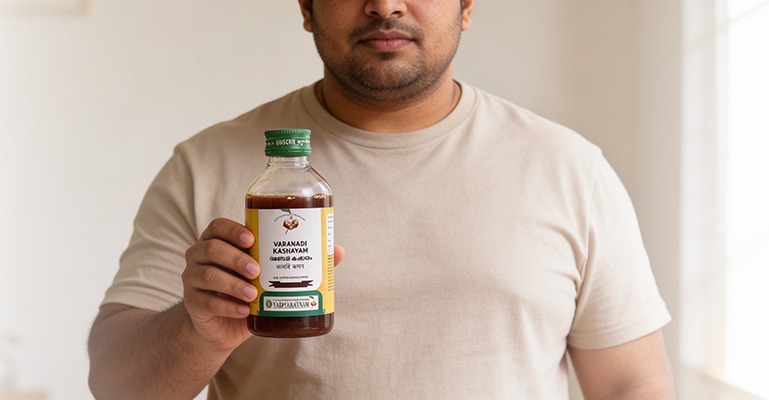
Among the classical Ayurvedic formulations traditionally used in the context of Kapha-Meda imbalance, Varanadi Kashayam is one that Ayurvedic texts reference specifically for conditions like obesity, headaches, and inflammatory states. It is a compound decoction - meaning it brings together multiple herbs; each selected for a particular role in the overall therapeutic action.
The formulation draws on herbs like Varana, Chitraka, Bilva, Sigru, and Hareethaki, among others - a combination that broadly targets sluggish digestion, excess Kapha, and accumulated fat tissue. It is taken before meals, under the supervision of a qualified Ayurvedic physician.
It is not a standalone solution, nor is it suitable for everyone. Like most classical Ayurvedic preparations, its use depends heavily on the individual's constitution, the degree of imbalance, and the overall treatment plan prescribed by a practitioner. But as part of a well-structured Ayurvedic protocol, it represents the kind of time-tested, multi-herb approach that has been central to obesity treatment in Ayurveda for centuries.
The Gut-Weight Connection in Ayurveda
Long before modern science began exploring the gut microbiome's role in weight regulation, Ayurveda was emphasising the centrality of digestive health in obesity. The concept of Ama - undigested metabolic waste that accumulates when Agni is weak — maps closely onto what we now understand about inflammation, insulin resistance, and gut dysbiosis.
When Ama accumulates, it clogs the body's channels (srotas), interferes with nutrient absorption, and creates a kind of metabolic fog. The body doesn't know what to do with what it's taking in, so it stores it. This is why obesity treatment in Ayurveda places such strong emphasis on clearing Ama and restoring Agni before anything else. Piling more food on top of poor digestion - even healthy food - doesn't resolve the underlying problem.
This is also why the timing and quality of meals matter so much in Ayurvedic practice. Eating at consistent times, avoiding overeating, and choosing foods appropriate to the season and one's constitution are not just good habits - they are therapeutic tools.
Mental and Emotional Dimensions of Obesity
Ayurveda has never treated the body in isolation from the mind. The concept of Satva (mental clarity), Rajas (activity and desire), and Tamas (inertia and heaviness) is directly relevant to obesity. Excessive Tamas - characterised by lethargy, poor motivation, emotional heaviness, and a tendency toward comfort eating - is often seen alongside Kapha imbalance in people struggling with weight.
This is not a moral judgment. It's a physiological reality. When the mind is heavy and the body is sluggish, change feels enormously difficult. Ayurvedic practice addresses this through rhythmic routines, light and stimulating foods, appropriate herbs, and mind-body practices like yoga and pranayama that gradually shift the mental and physical state together.
This holistic integration is one reason why obesity treatment in Ayurveda tends to be a sustained journey rather than a quick fix - and why, for those who commit to it, the results often extend well beyond weight loss into improved energy, clarity, and overall wellbeing.
What to Expect When You Take the Ayurvedic Route
If you're considering Ayurveda for weight management, here are a few honest things to keep in mind:
It takes time. Ayurvedic treatments are not designed for rapid, dramatic results. They work gradually, addressing root causes rather than surface symptoms. Most practitioners suggest giving it a minimum of three to six months to see meaningful change.
It requires commitment. Dietary and lifestyle adjustments are not optional add-ons - they are central to the treatment. Medicines alone, without corresponding changes in how you eat and live, will have a limited impact.
It is an individual. What works well for one person may not suit another. Ayurveda is deeply personalized, which is why consulting an experienced Ayurvedic physician before starting any formulation is important.
It is safe, but not without guidance. Classical Ayurvedic medicines are generally well-tolerated, but appropriate dosage, timing, and formulation selection depend on individual factors. Self-medicating based on general information is not advisable.
Closing Thoughts
Obesity, in Ayurveda, is not a failure of willpower. It is a sign that something in the body's natural rhythm has gone off course - digestion has weakened, doshas have shifted, and the tissues are no longer functioning in balance. The good news is that the body has an extraordinary capacity to recalibrate, given the right conditions.
Obesity treatment in Ayurveda works by creating those conditions - through food, herbs, lifestyle, and an understanding of the individual. It's a slower road, but it tends to be a more lasting one. And perhaps more importantly, it treats the person, not just the problem.
Classical Ayurvedic formulations used in this space are often sourced from long-established manufacturers who follow traditional preparation methods. Vaidyaratnam Oushadhasala is one such institution - a Kerala-based Ayurvedic pharmacy with deep roots in classical medicine, known for preparing formulations according to time-tested textual references.
If you've been feeling like modern approaches have only given you part of the picture, Ayurveda might be worth exploring - ideally with the support of a qualified practitioner who can guide you through it properly.