 Consultation
now
Consultation
now



-
Arishtas & Asavaas
-
Wellness
-
Food Supplements
-
Choornam
-
Combo Pack








My Cart (0)



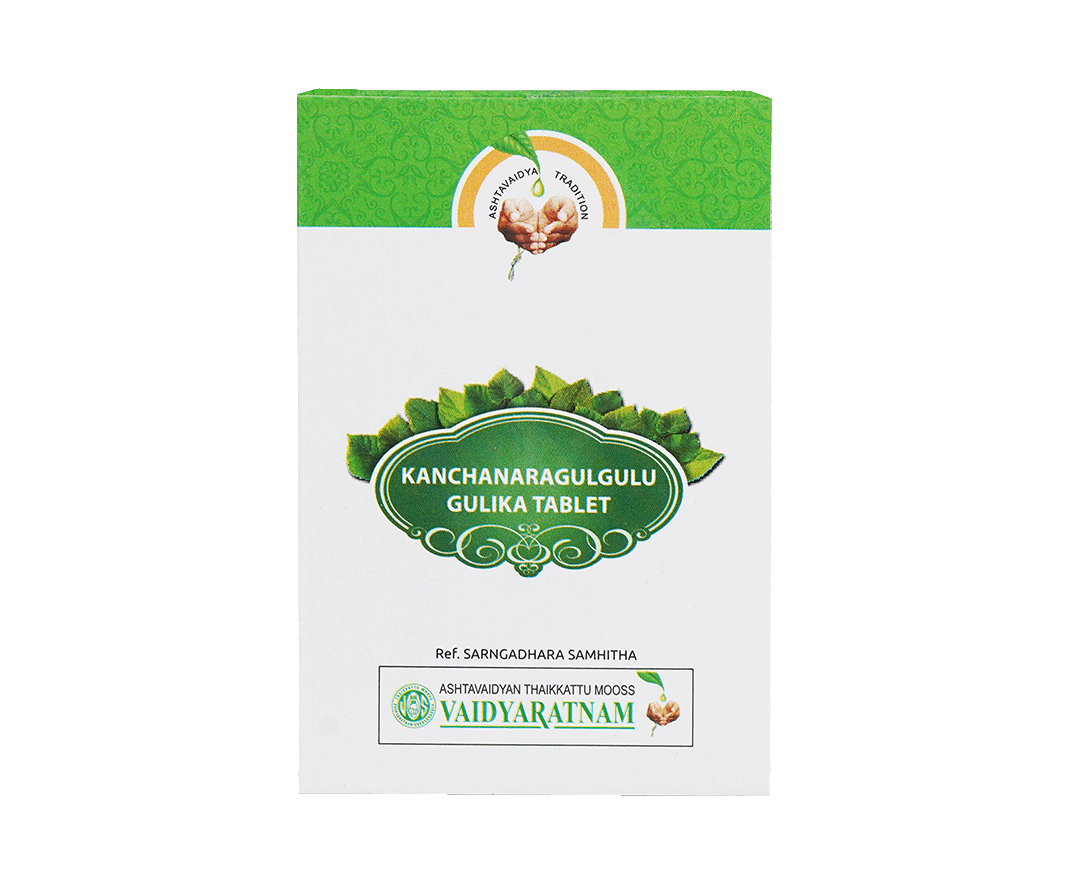
KANCHANARA GULGULU GULIKA TABLET 100 NOS
Ayurveda
Above ₹999
Driven
 Cash on Delivery: ₹150
Free Shipping above ₹999
Cash on Delivery: ₹150
Free Shipping above ₹999
 7 Days Return Policy
Delivery
check
The product will be delivered within 2-10 working days, depending on your location. For more details, please refer to the TAT table in our Delivery Policy.


Description
| Ingredients | Scientific Name | Qty |
|---|---|---|
| Powder of : | ||
| Kanchanara | Bauhinia variegata (St.Bk.) | 144.5 mg |
| Hareethaki | Terminalia chebula (P.) | 28.9 mg |
| Vibheethaki | Terminalia bellirica (P.) | 28.9 mg |
| Amalaki | Phyllanthus emblica (P.) | 28.9 mg |
| Sunti | Zingiber officinale (Rz.) | 14.45 mg |
| Maricha | Piper nigrum (Fr.) | 14.45 mg |
| Pippali | Piper longum (Fr.) | 14.45 mg |
| Varana | Crataeva nurvala (St.Bk.) | 4.82 mg |
| Ela | Elettaria cardamomum (Sd.) | 3.6 mg |
| Twak | Cinnamomum zeylanicum (St. Bk.) | 3.6 mg |
| Patra | Cinnamomum tamala (Lf.) | 3.6 mg |
| Base & Others : | ||
| Guggulu | Commiphora wightii (O.R.)(Purified) | 300 mg |
Indications:
Goiter, Ulcer, Skin Diseases and Fistula
Dosage:
1 to 2 tablets twice daily with proper adjuvant or as directed by the Physician
Reviews
Related Blogs

19 September 2025
Best Ayurvedic Herbs to Promote Youthful Skin
Aging is a natural process, but for many, wrinkles, fine lines, and sagging skin arrive earlier t...
Read More

30 September 2026
Thyroid Disorders and Their Treatment in Ayurveda
Quick Answer:
Ayurveda views thyroid disorders as a disturbance of the dig...
FAQ
It is a classical Ayurvedic herbal tablet used to support lymphatic health, thyroid balance, and to reduce abnormal glandular or tissue growth.
It reduces Kapha accumulation, supports lymphatic drainage, improves metabolism, and helps shrink abnormal growth.
Yes. It is commonly prescribed to support thyroid functions alongside other Ayurvedic treatments.
Commonly 1–2 tablets, twice daily, but must be taken as directed by an Ayurvedic doctor.
Chronic conditions may need 6–12 weeks or longer depending on severity and metabolism.
Generally, safe. Some may experience mild acidity or digestive discomfort due to Guggulu.