 Consultation
now
Consultation
now



-
Arishtas & Asavaas
-
Wellness
-
Food Supplements
-
Choornam
-
Combo Pack








My Cart (0)



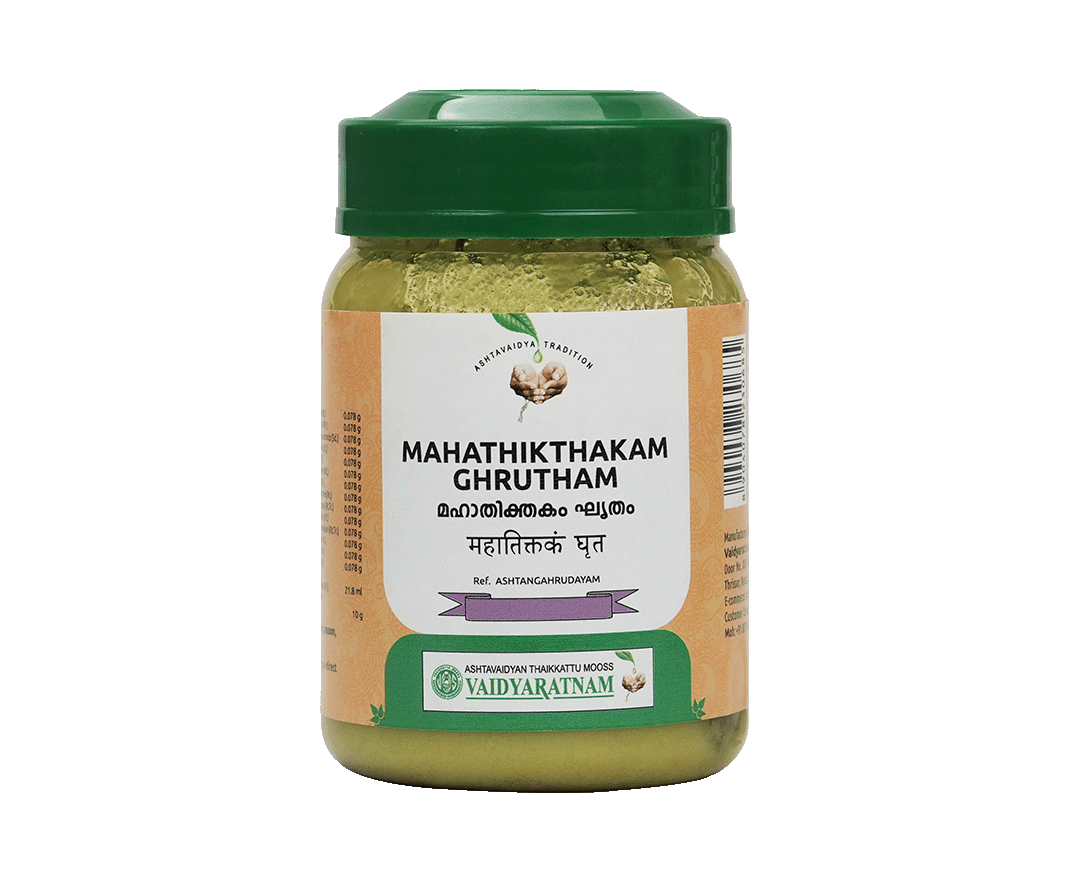
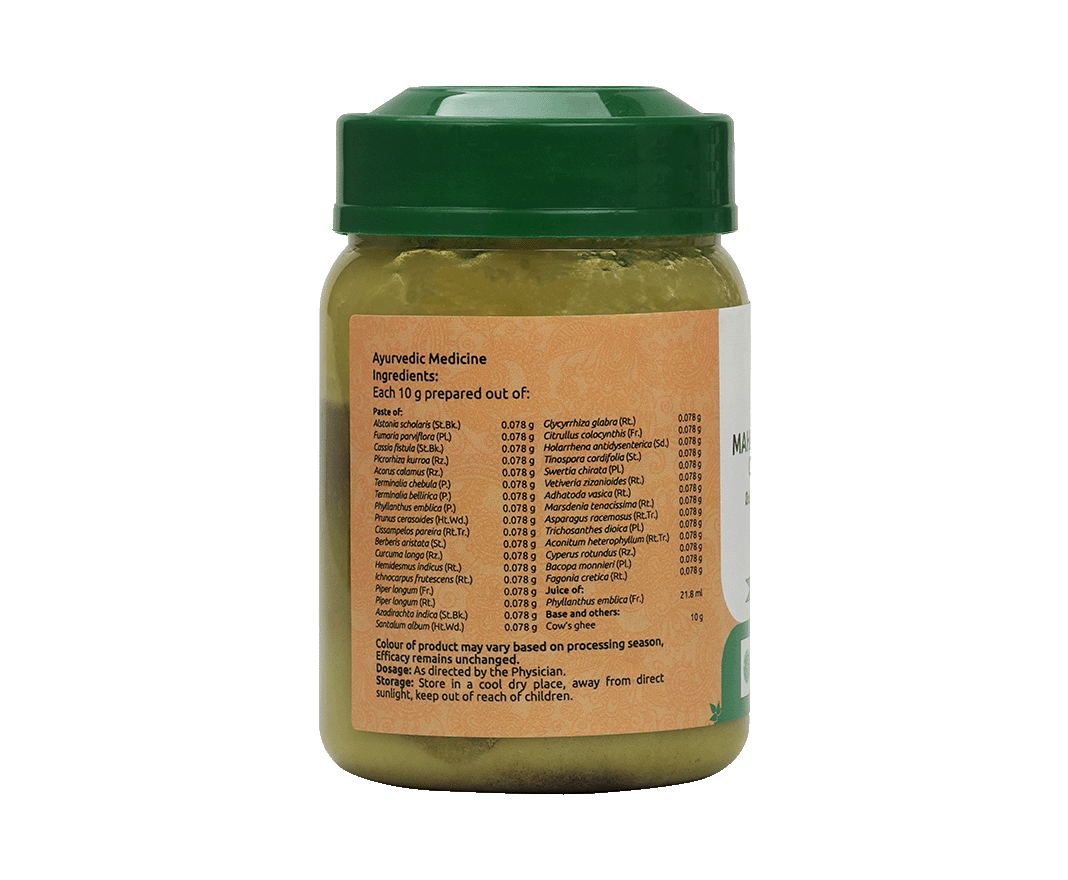
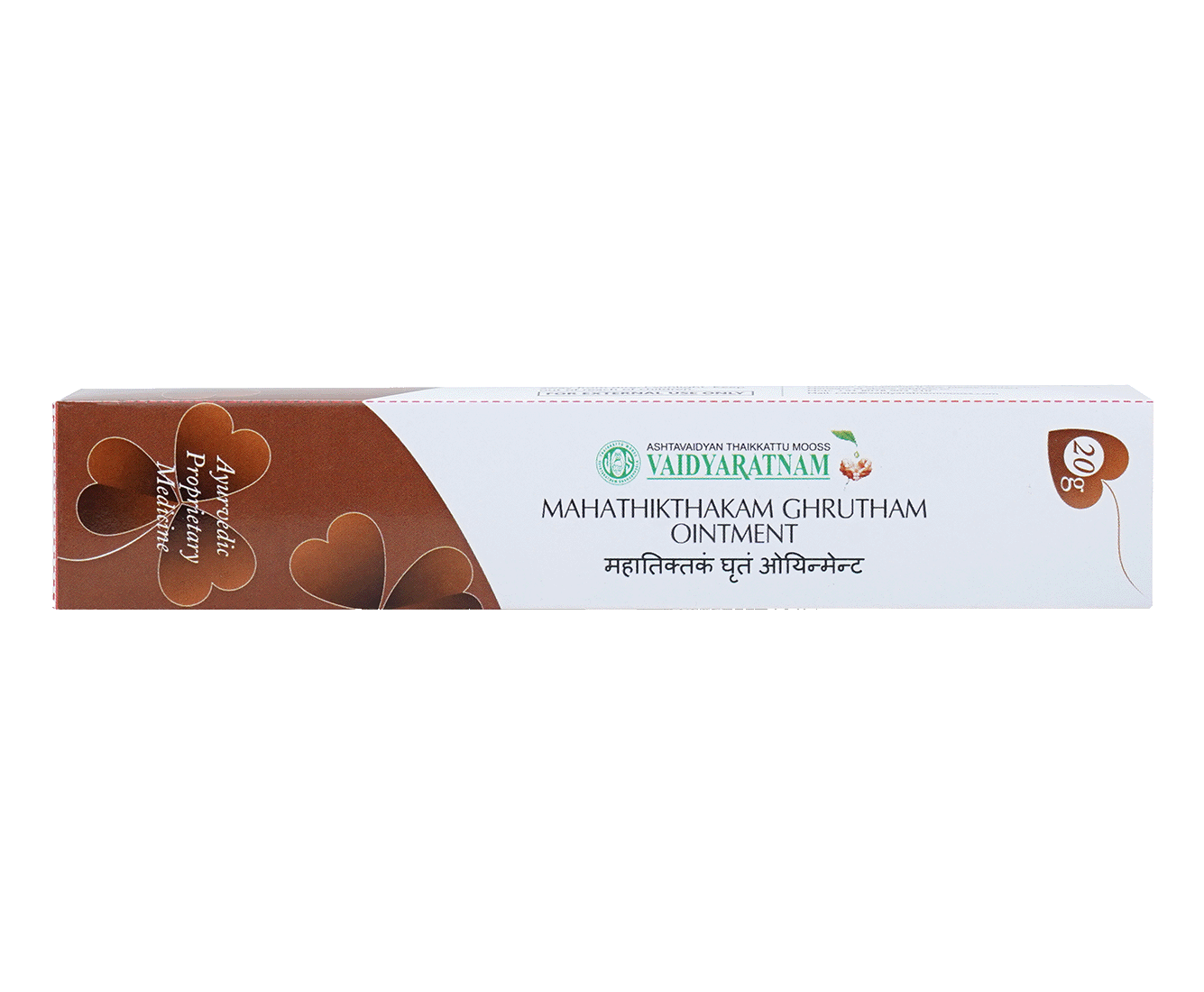
MAHATHIKTHAKAM GHRUTHAM 150 GM
Ayurveda
Above ₹999
Driven
 Cash on Delivery: ₹150
Free Shipping above ₹999
Cash on Delivery: ₹150
Free Shipping above ₹999
 7 Days Return Policy
Delivery
check
The product will be delivered within 2-10 working days, depending on your location. For more details, please refer to the TAT table in our Delivery Policy.


Description
| Ingredients | Scientific Name | Qty |
|---|---|---|
| Paste of : | ||
| Saptaparna | Alstonia scholaris (St.Bk.) | 0.078 g |
| Parpata | Fumaria parviflora (Pl.) | 0.078 g |
| Aragwadha | Cassia fistula (St.Bk.) | 0.078 g |
| Katuka | Picrorhiza kurroa (Rz.) | 0.078 g |
| Vacha | Acorus calamus (Rz.) | 0.078 g |
| Hareethaki | Terminalia chebula (P.) | 0.078 g |
| Vibheethaki | Terminalia bellirica (P.) | 0.078 g |
| Amalaki | Phyllanthus emblica (P.) | 0.078 g |
| Padmaka | Prunus cerasoides (Ht.Wd.) | 0.078 g |
| Pata | Cissampelos pareira (Rt.Tr.) | 0.078 g |
| Daruharidra | Berberis aristata (St.) | 0.078 g |
| Haridra | Curcuma longa (Rz.) | 0.078 g |
| Sariba | Hemidesmus indicus (Rt.) | 0.078 g |
| Krishnasariva | Ichnocarpus frutescens (Rt.) | 0.078 g |
| Pippali | Piper longum (Fr.) | 0.078 g |
| Pippalimoola | Piper longum (Rt.) | 0.078 g |
| Nimba | Azadirachta indica (St.Bk.) | 0.078 g |
| Chandana | Santalum album (Ht.Wd.) | 0.078 g |
| Yashtimadhu | Glycyrrhiza glabra (Rt.) | 0.078 g |
| Indravaruni | Citrullus colocynthis (Fr.) | 0.078 g |
| Kutaja | Holarrhena antidysenterica (Sd.) | 0.078 g |
| Guduchi | Tinospora cordifolia (St.) | 0.078 g |
| Kirathathiktha | Swertia chirata (Pl.) | 0.078 g |
| Useera | Vetiveria zizanioides (Rt.) | 0.078 g |
| Vasa | Adhatoda vasica (Rt.) | 0.078 g |
| Murva | Marsdenia tenacissima (Rt.) | 0.078 g |
| Satavari | Asparagus racemosus (Rt.Tr.) | 0.078 g |
| Patola | Trichosanthes dioica (Pl.) | 0.078 g |
| Athivisha | Aconitum heterophyllum (Rt.Tr.) | 0.078 g |
| Mustha | Cyperus rotundus (Rz.) | 0.078 g |
| Brahmi | Bacopa monnieri (Pl.) | 0.078 g |
| Duralabha | Fagonia cretica (Rt.) | 0.078 g |
| Juice of : | ||
| Amalaki | Phyllanthus emblica (Fr.) | 21.8 ml |
| Base & Others : | ||
| Ghrutha | Cow's ghee | 10 g |
Indications:
Skin diseases, Ulcers and Fistula
Dosage:
10 to 20 g or as directed by the Physician
Reviews



FAQ
It is a classical Ayurvedic medicated ghee prepared with multiple bitter herbs, traditionally used for skin diseases, ulcers, and fistula.
It is commonly indicated for skin disorders (Kushta), chronic ulcers (Vrana), and fistula (Bhagandara).
It helps balance aggravated Pitta and purify Rakta (blood) while nourishing tissues through its ghee base.
Typically 5–10 grams once or twice daily, or as prescribed by an Ayurvedic doctor.
It is usually taken after food or as directed by a practitioner.
Yes, traditionally it is used in psoriasis-like conditions, but medical supervision is recommended.
It may be recommended in eczema associated with Pitta imbalance.
Yes, it is traditionally used for chronic non-healing ulcers.
It is used as supportive therapy in fistula management, often alongside procedures like Kshara Sutra.
Duration varies depending on the condition; chronic skin issues may require longer courses.