 Consultation
now
Consultation
now



-
Arishtas & Asavaas
-
Wellness
-
Food Supplements
-
Choornam
-
Combo Pack








My Cart (0)



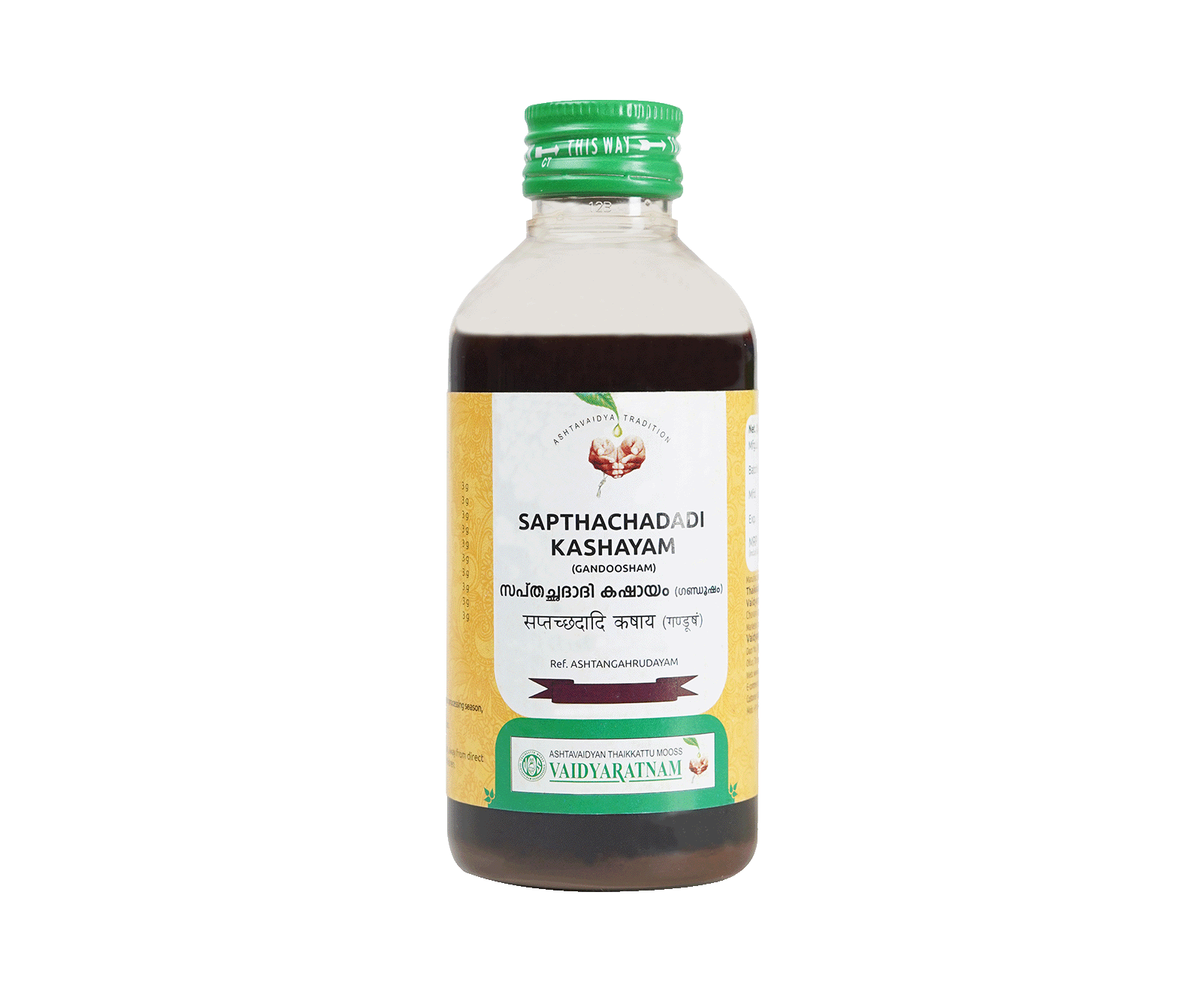
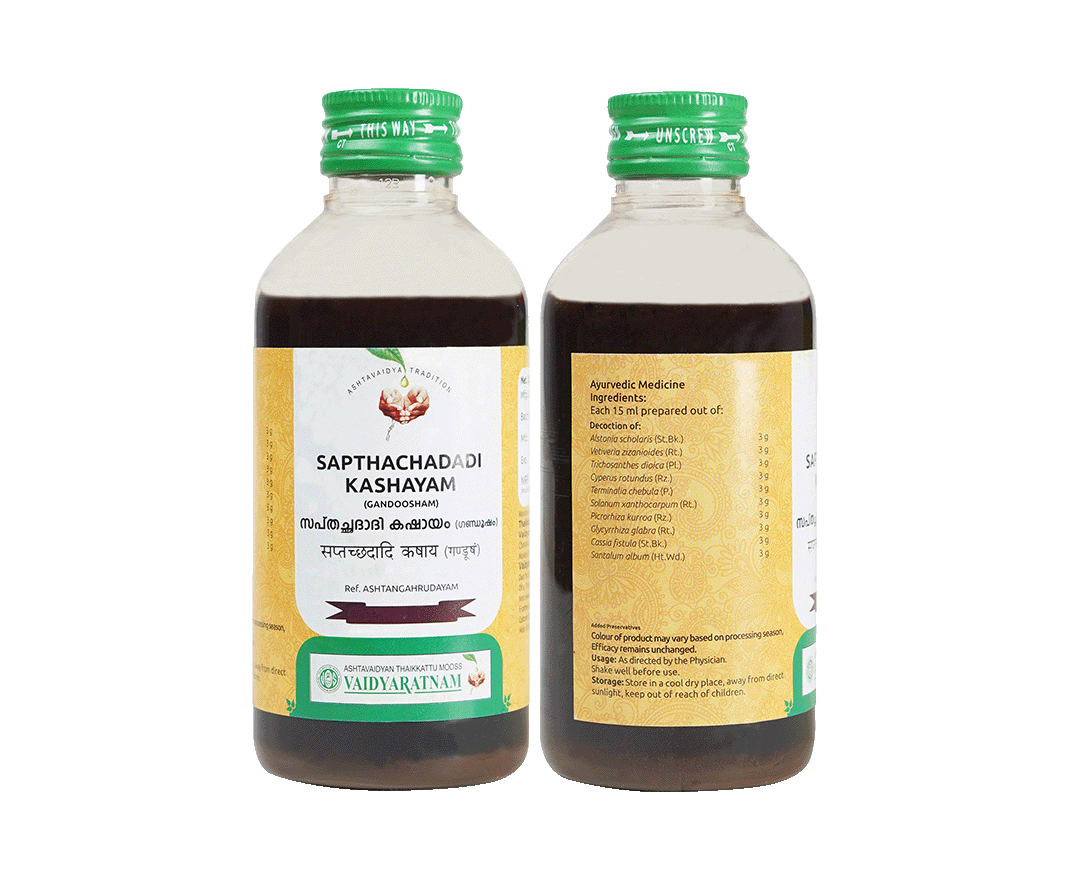
SAPTHACHADADI GANDOOSHAM KASHAYAM 200 ML
Ayurveda
Above ₹999
Driven
 Cash on Delivery: ₹150
Free Shipping above ₹999
Cash on Delivery: ₹150
Free Shipping above ₹999
 7 Days Return Policy
Delivery
check
The product will be delivered within 2-10 working days, depending on your location. For more details, please refer to the TAT table in our Delivery Policy.


Description
| Ingredients | Scientific Name | Qty |
|---|---|---|
| Decoction of : | ||
| Sapthaparna | Alstonia scholaris (St.Bk.) | 3 g |
| Useera | Vetiveria zizanioides (Rt.) | 3 g |
| Patola | Trichosanthes dioica (Pl.) | 3 g |
| Mustha | Cyperus rotundus (Rz.) | 3 g |
| Hareethaki | Terminalia chebula (P.) | 3 g |
| Kandakari | Solanum xanthocarpum (Rt.) | 3 g |
| Katuka | Picrorhiza kurroa (Rz.) | 3 g |
| Yashtimadhu | Glycyrrhiza glabra (Rt.) | 3 g |
| Aragwadha | Cassia fistula (St.Bk.) | 3 g |
| Chandana | Santalum album (Ht.Wd.) | 3 g |
Indications:
Mouth ulcers and Oral infection
Dosage:
For gargling
Reviews
Related Products
FAQ
It is a classical Ayurvedic herbal decoction used mainly for gargling (gandoosham) to maintain oral health.
It is indicated for mouth ulcers and oral infections.
It is used as a mouth rinse or gargle, not meant for regular swallowing.
Gandoosham is an Ayurvedic practice of holding or gargling medicated liquid in the mouth for oral hygiene and treatment.
Yes, it is traditionally used to soothe and heal mouth ulcers.
Yes, it helps reduce infection, inflammation, and discomfort in the mouth.
Yes, it may help with gum inflammation and oral irritation.
Usually once or twice daily, or as advised by an Ayurvedic physician.
It is generally diluted with lukewarm water before gargling.
Long-term use should be done under the guidance of an Ayurvedic doctor.
Yes, it has a bitter and herbal taste, typical of Ayurvedic kashayams.
Relief may be noticed within a few days, depending on the condition.